Mid-infrared fibers : frequency conversion and ultrafast applications
Contents
The mid-infrared (MIR, mid-infrared) covers the 2-20 µm wavelength range, located just beyond the near-infrared used in fiber optic telecoms (850-1550 nm). Fibers able to carry this range open up advanced applications in molecular spectroscopy, medical imaging, laser surgery and atmospheric communications.
This article explains how gas-filled hollow-core fibers (HCF) make it possible to convert ultrafast laser pulses from 1 µm to the mid-infrared via a nonlinear phenomenon called extreme Raman shifting, and which industrial applications this technology enables.
Tunable frequency conversion of ultrafast pulses long remained confined to optical parametric amplifiers (OPA), complex and costly systems. Nitrogen-filled hollow-core fibers change the game: the same efficiency, the simplicity of a plain cable.
What is the mid-infrared in optics ?
The mid-infrared refers to the portion of the electromagnetic spectrum between 2 µm and 20 µm (some definitions extend it to 50 µm). Unlike the near-infrared (0.78-2 µm) used throughout fiber telecoms, the MIR is absorbed by conventional silica — making it unusable with standard SiO₂-based optical fibers.
To carry the MIR in a fiber, you need either :
- Fluoride fibers (ZBLAN, InF₃) or chalcogenide (As₂S₃, As₂Se₃) — transparent up to 10 µm, but fragile and expensive
- Hollow-core fibers (HCF) where light propagates in air or a gas, avoiding absorption by the glass
- Photonic crystal fibers (PCF) with confinement through a photonic bandgap
The 3 types of hollow-core fiber (HCF)
Hollow-core fibers trap light in a central air channel via different physical mechanisms :
| HCF type | Mechanism | Spectral range | Distinctive feature |
|---|---|---|---|
| Photonic bandgap (PBG) | Periodic Bragg reflection | 500 nm – 2 µm | Complex fabrication, low loss within the band |
| Negative curvature (NCF) | Wall anti-resonance | 300 nm – 4 µm | Wide band, low dispersion |
| Bragg cladding | Multi-layer dielectric coatings | 2 – 10 µm | Suited to MIR, advanced engineering |
HCF fibers make it possible to fill the central channel with a chosen gas (argon, nitrogen, xenon) whose nonlinear optical properties determine the phenomena that can be exploited.
Principle of extreme Raman shifting
The Raman effect is an inelastic scattering phenomenon in which an incident photon loses part of its energy to a vibrational or rotational level of the molecule. In a nitrogen-filled hollow-core fiber, a 1 µm laser pump pulse undergoes an extreme Raman shift toward the infrared (extreme Raman red-shifting).
Key concept
A 200 fs ultrafast pulse at 1 µm, injected into a 5-6 m nitrogen-filled hollow-core fiber, comes out at a longer wavelength (1.0-1.7 µm) with a duration 3 times shorter (~20 fs). This is extreme Raman shifting coupled with self-compression.
The mechanisms involved :
- Molecular rotation of the gas (nitrogen N₂) in the intense field of the laser
- Asymmetric spectral broadening toward longer wavelengths (red)
- Spectral filtering to isolate the desired infrared band
- Temporal recompression via broadband chirped mirrors
TUWien, INRS and Moscow experiments
Three research groups have experimentally validated this technique :
Parameters of the experimental setups
| Team | HCF fiber | Pump pulse | Result |
|---|---|---|---|
| TUWien (Austria) | 5.5 m × 1 mm ID | 200 fs, 1.03 µm, Yb laser | Shift 1.0-1.7 µm, compression 20 fs |
| INRS (Canada) | 6 m × 0.53 mm ID | 200 fs, 1.03 µm + chirped mirrors | Optimized temporal compression |
| Zheltikov group (Moscow) | Theoretical modeling | N/A | Validated physical model |
Combining experiment (TUWien/INRS) with theory (Moscow) made it possible to fully validate the underlying dynamics and establish a reproducible method.
Industrial and medical applications
Ultrafast mid-infrared laser sources open up major fields of application :
- Molecular spectroscopy — most biological and chemical molecules have their fundamental vibrational bands in the MIR (2-10 µm). Explosives detection, pharmaceutical quality control, atmospheric analysis
- Medical optical coherence tomography (OCT) — non-invasive high-resolution imaging in ophthalmology, dermatology, cardiology
- High harmonic generation (HHG) — creation of XUV and X-ray sources for attosecond physics
- Laser surgery — precise tissue ablation (wavelength absorbed by water)
- Free-space optical communications (FSO) — MIR transmission windows in air
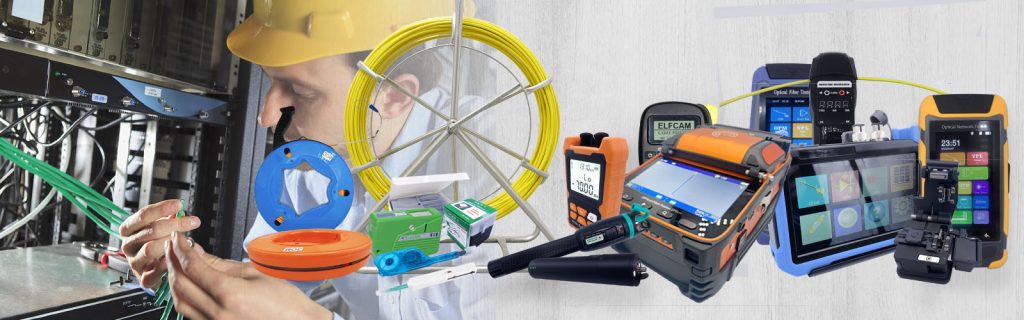
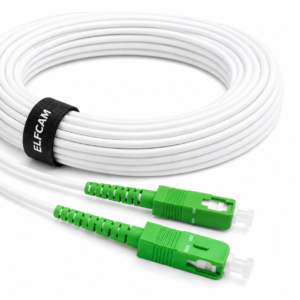
Elfcam fibers and equipment
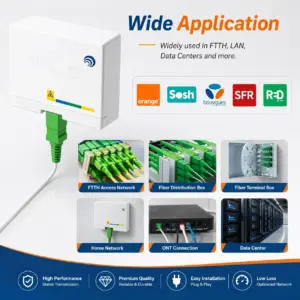
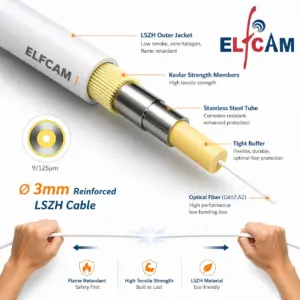
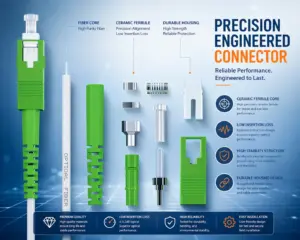
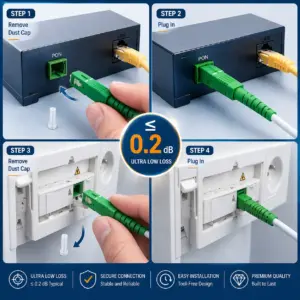
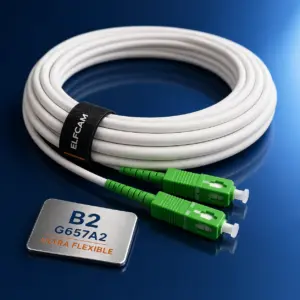
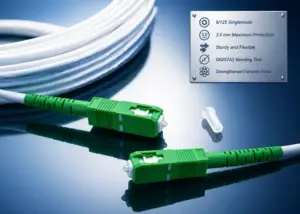
Our standard range covers the near-infrared (1310/1550 nm telecoms). For specialized MIR applications, contact our team via the Support page for a custom quote on fluoride or chalcogenide fibers (special order).
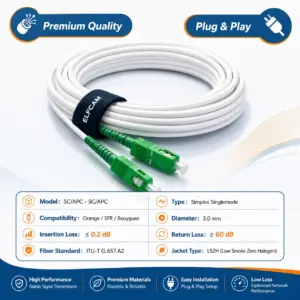
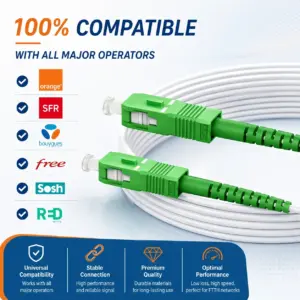
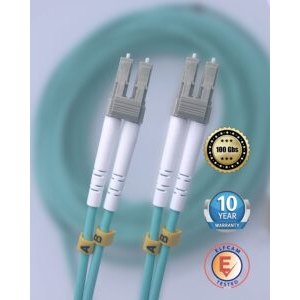
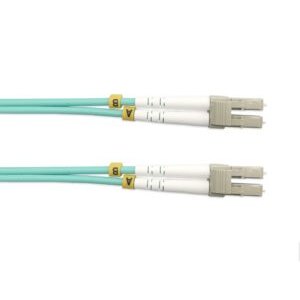
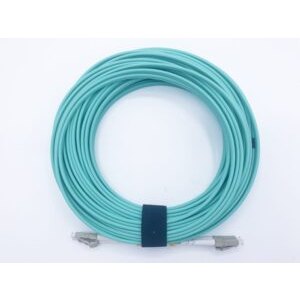
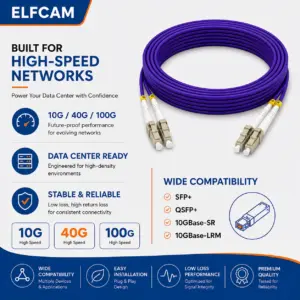
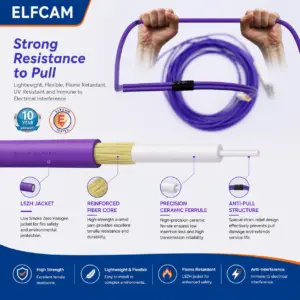
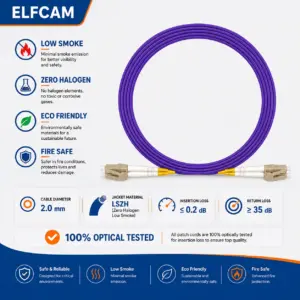
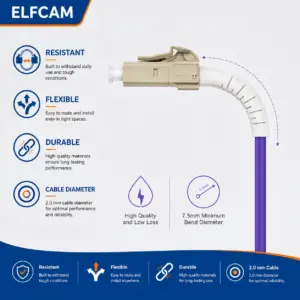
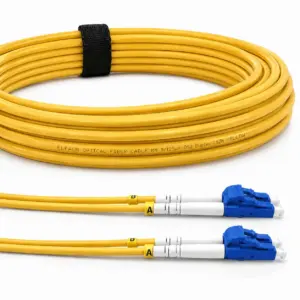
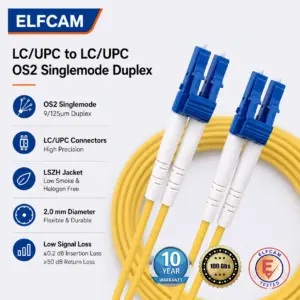
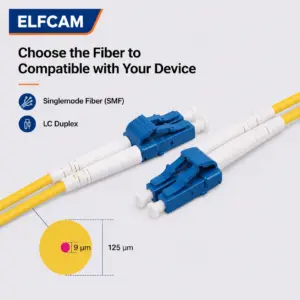
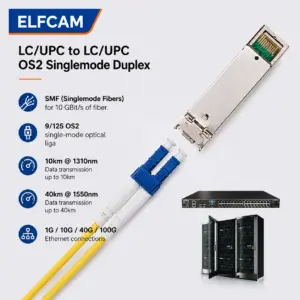
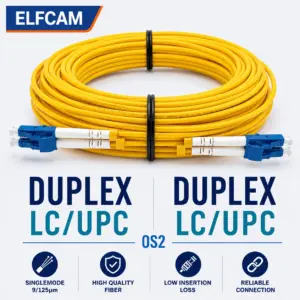
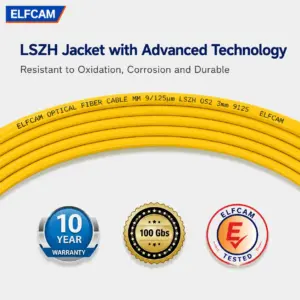
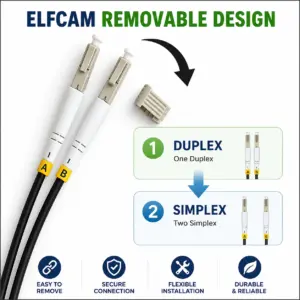
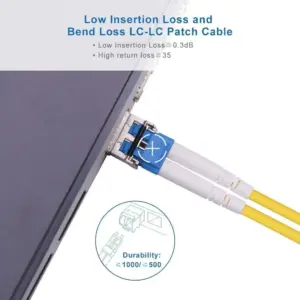
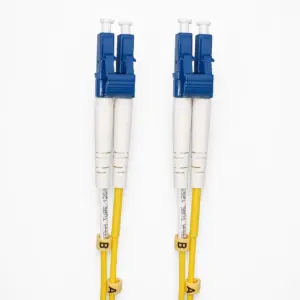
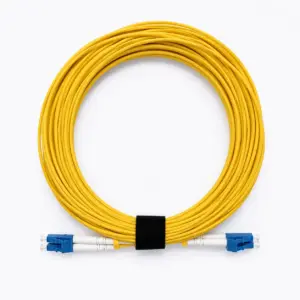
- OS2 single-mode fibers — telecoms standard, patch cords and multi-strand cables
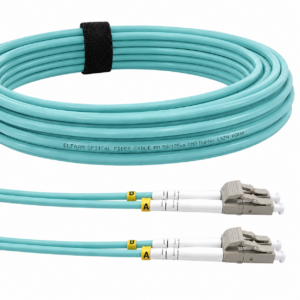
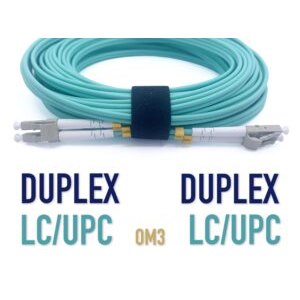
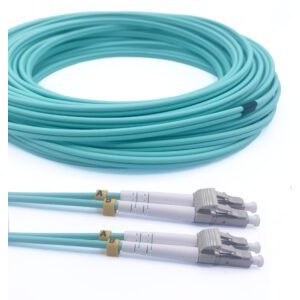
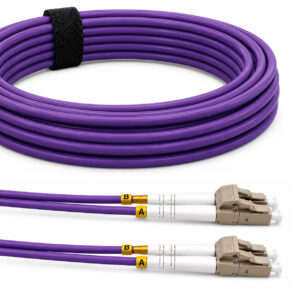
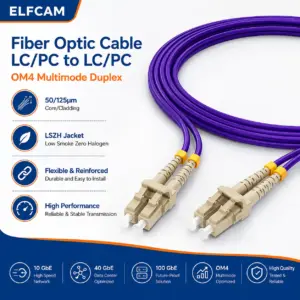
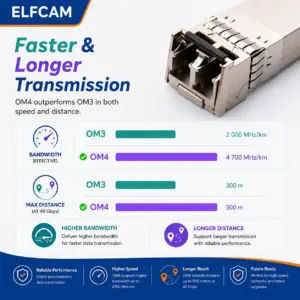
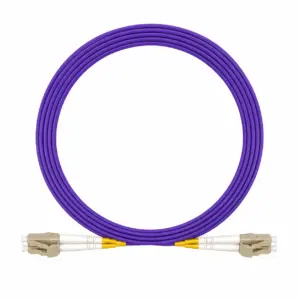
- OM3/OM4 multimode fibers — datacenter 850 nm laser-optimized
- SFP/SFP+ modules — 1310/1490/1550 nm transceivers

Standard fiber vs hollow-core fiber
| Criterion | Standard fiber (silica) | Hollow-core fiber (HCF) |
|---|---|---|
| Core material | Germanium-doped silica | Air or gas |
| Usable spectral range | 0.4 – 1.8 µm | 0.3 – 10 µm (by type) |
| Insertion loss | 0.2 dB/km @ 1550 nm | 1-10 dB/km (highly variable) |
| Cost | Low (industrial production) | High (complex fabrication) |
| Applications | Telecoms, datacenter | Research, MIR laser, sensors |
| Availability | Permanent stock | Special order |
FAQ — Mid-infrared fibers
1Why can't silica carry the mid-infrared ?
2What is an ultrafast pulse ?
3What is the difference between OPA and hollow-core fiber conversion ?
Nitrogen-filled hollow-core fibers offer a simple and economical alternative for the 1.0-1.7 µm range, with the bonus of temporal self-compression of the pulses (200 fs → 20 fs).
4What is the Raman effect in fibers ?
5Where are these fibers used in medicine ?
6Can you buy a hollow-core fiber from stock ?
7How much power can pass through an HCF ?
8Does Elfcam sell solutions for laser research ?
In summary
Mid-infrared fibers, in particular gas-filled hollow-core fibers (HCF), represent a technological breakthrough for ultrafast laser frequency conversion. They make accessible the MIR sources previously reserved for large laboratories equipped with OPA.
For standard telecoms applications (FTTH, datacenter, 10G/25G/100G), our classic silica fiber optic cables, SFP/SFP+ modules and adapters remain the default choice.